

The Escape Route
They left their abundant homeland to become refugees of not another land ; It was their own country that had split into two nations and suddenly they were misfits in the land of their birth, the land of their ancestors. One could argue that they weren’t the only ones – the impact was borne by other communities too, yet, there was a stark difference. The two countries had their own Hyderabad, their own Punjab and furthermore even another Bengal was created but the zealous yet timid Sindhis got no land to call their own post the partition.
They lived as refugees in various parts of the Hind that was not that far, yet extremely far Sindh. Having lived in their huge mansions, it was traumatic to live in the congested camps with meagre belongings. They had left behind a huge chunk of their way of living, their luxuries, their property and some even got separated from their loved ones. To leave was not a choice, it was a necessity that arose from protecting their dharmic values -being born as Hindus they chose to die as Hindus. It would have been easier to convert to the other faith and continue living there, but their morals did not permit them to do so.
Ganga and her next door neighbor and friend Pevi had lived like madams in their own huge premises and between the two friends – they had a dozen children. When the call for partition came their husbands were in a rush to sell off the property and escape. However, that would have taken some time and it wasn’t any safe for the women and children to be at risk at such a vulnerable time. They told the family to escape to the Hindu territory whilst they could manage the affairs and then leave.
The ladies left along with a dozen kids tagging along. The transport was becoming an issue and in the process of reaching the border they had to part away with a lot of their wealth. Ironically, things haven’t changed much from those days – alone women, unescorted by men are often gullible and taken advantage of. Children were quite young and the slightly older ones had the responsibility of gripping hold on the younger ones hence they couldn’t have carried much luggage with them.
Pevi and Ganga were told at the border that al the vehicles were overloaded and there wasn’t any space left for them to board. They pleaded to the guards to allow them as they had young daughters with them and it wasn’t safe to stay put like that in such a place. Slyly the guards laughed out and told them to leave the daughters under their care and that sent shivers across the spines of these mothers.
They were scared, they had to migrate to the other side somehow but had no resources left with them. The journey till the border had made them sacrifice a lot. They checked with each other and realized that they both were left with a gold coin each. The smart brain of the Sindhi women played its part. They offered to bribe the guard to be allowed to escape through an underground tunnel that they had come to learn about from their sources.
One of the guards appeared a bit soft so they targeted him. They told him that they were left with just one gold coin and they were willing to give it to him if he allowed all of them to escape through the tunnel. He was charmed by the bribe and allowed them. Pevi chose to lead the path, leaving her infant child with Ganga, as it still needed some digging on the way. Ganga decided to let the children follow Pevi and then giving the coin to the guard followed the trail holding two infants in her grip – her son and Pevi’s daughter. The toddlers were well taken care of by older siblings as they balanced themselves with the little bit luggage and the younger ones.
It was a long struggle passing through the roughly dug, dark and dreary tunnel with hungry and fearful children being told not to cry or they might be caught. The babies and toddlers mouths were tied up by scarves so they don’t cry out innocently. They weren’t sure if they would finally make it to the other end and a thought even came across Ganga’s mind ,”What if the news about the tunnel was false and they land up in the same country”. She was worried as she had given away the only coin she was left with and had six children to feed till her husband could reach them.
Patience and perseverance paid off finally as they reached the other end of the tunnel and the area seemed very unfamiliar. Pevi went out first with two children and told the rest to stay put while she could check out the situation. Once she was convinced that they were in Hindustan, she signaled the rest of them to come out and gave a helping hand to each one to pull up and out from the dark tunnel. Some people questioned them about their being non Hindus and they successfully convinced them and then asked for help and were assisted by some security personnel and brought to a refugee camp.
Settling Down
Then finding their relatives and meeting their husbands after few weeks they gradually picked up the threads of their lives and started afresh. Life was tough, challenges brought in a new issue every time but they braved it and faced it all with the assurance that they were safe in this land. There were hundreds and thousands like them that had similar stories and each one found a way out somehow but eventually they got scattered to various parts of this new India and submerged themselves with the speech, the dialect, the mannerisms, the food habits, the attire and a lot more to be accepted by the local population as one amongst the rest of them.
Cultural Loss
In the process, Their ways of worshipping hadn’t changed but got altered a bit as they picked up new strands of religion by getting introduced to Ganpati Bappa and somewhat missing out on Jhulelal devotion, Fasting for Navratri and Ganpati festival but missing out on Lal Saeein jo Chaliho fasting, Visiting Vaishno Devi and missing out on Hinglaj Mata darshan. They didn’t mind it as this made them fit into the society they were part of, happy at being Hindu enough at least.
A bigger sacrifice was unknowingly made of the language. The men no longer could work for someone doing their accounts in Vankai script, they had to learn to do it in Hindi or English or learn the language of the state they were in. Children too were initially being laughed upon when they spoke in their mother tongue because the trends had changed to accepting English or Hindi as the common language of communication. The Indian Government hadn’t given Sindhis a state, so to recognize their language seemed far fetched and Sindhi wasn’t taught in any of the schools for nearly twenty years. The parents had to encourage their young ones to learn the local languages adapt to this life. Hence an entire generation was deprived of the mother tongue Sindhi. In the process they lost the very precious aspect of their culture and the coming generations weren’t taught the language too as this wasn’t found attractive. English gained prominence and alas! the very force that caused the rift between the nation, still rules the population through its language. Not only Sindhis but entire Indian population is still colonized by language of the British. This article itself is proof of the same language colonization.
Today the Sindhis that still live in Sindh are struggling as they live in harsh, insecure conditions. Those whose forefathers couldn’t leave the region due to inability or due to their affection to their motherland are bearing a terrible brunt of the separatism of religions. Each day the Sindhi girls are falling victims to abductions, forceful marriages, forceful conversions and the Indian side is giving refuge to those who have managed to escape. It’s a matter to time, till they get the migrant status specified and they gain permits and are accepted as Indians.
As we witness these present day refugees , it brings to our minds the status our ancestors who would have faced similar, or even harsher situations and thus my heart goes out for them. They are residing in various camps in different parts of India and looking at them one realizes how much of our culture and traditions are forgotten by our Sindhis in India.
The children who come, they speak their native dialects such as Sindhi, saraiki, Gujarati which is albeit different fro the one we know of in the Indian side. They have to be taught Hindi and English to fit into the society – so history repeats itself again, right in front of our eyes. They are now gradually forgetting the Sindhi language as they pick the new languages to do the schooling and take up professions.
The womenfolk refuse to wear jeans, pants and tops and prefer traditional Indian outfits but in some time, this might change too in the guise of adaptation, acceptance and modernization. It would be only fair to label it as colonization by attire as the men have discarded their traditional salwars and opted for trousers like rest of the population.
The women folk oft times display their talent of the famous Sindhi embroidery and it must be promoted to a big extent to revive their rich art. Their traditional musical tones and folk music is incomparable and I urge those reading this to make some effort at reviving and popularizing this art too. Then of course in some camps such as Pune the women are making some income by making papads, Khicha and kachris that can be exported as well. More women must be encouraged at camps at other states as well to produce these traditional goodies and make our Sindhi food popular.
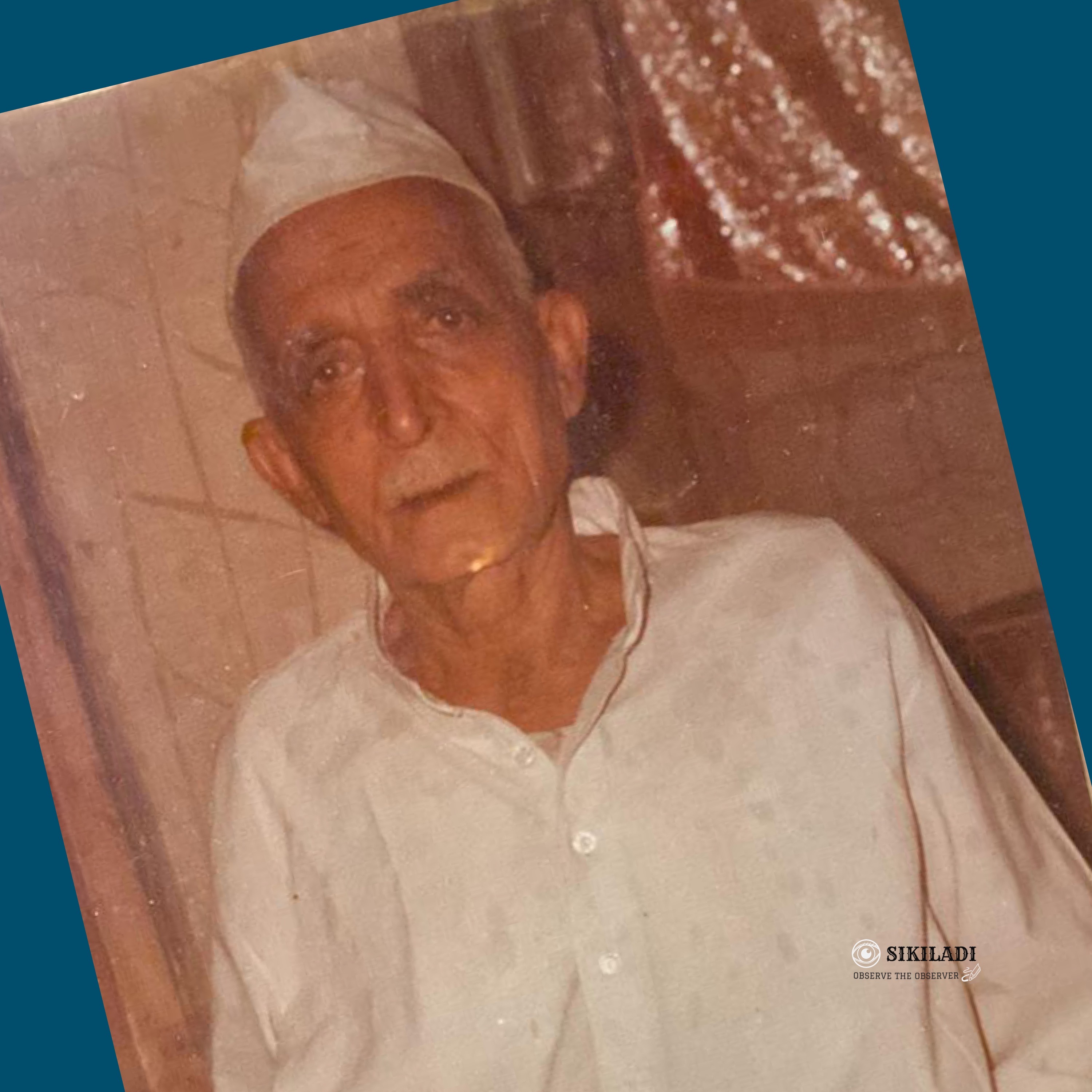
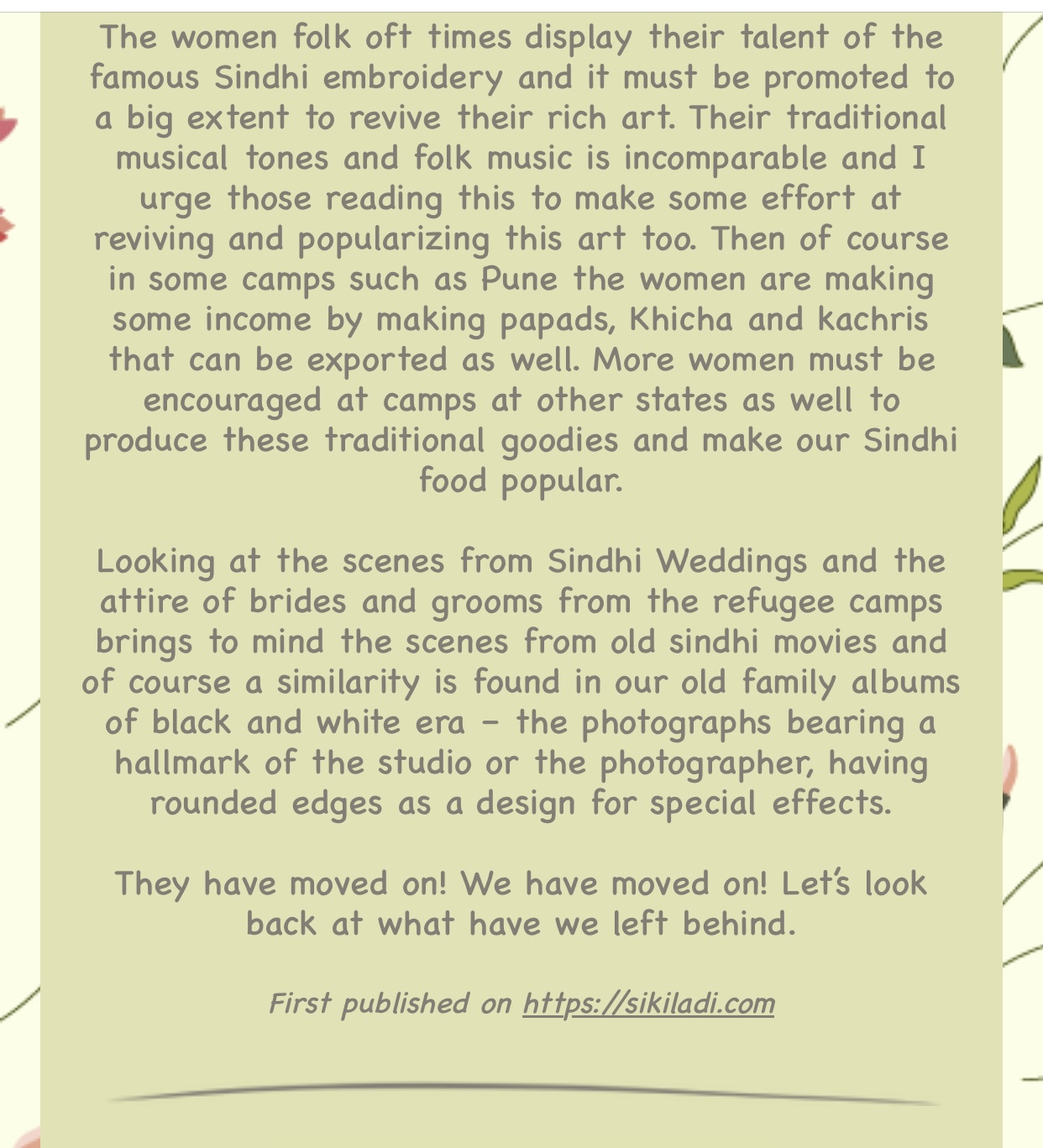
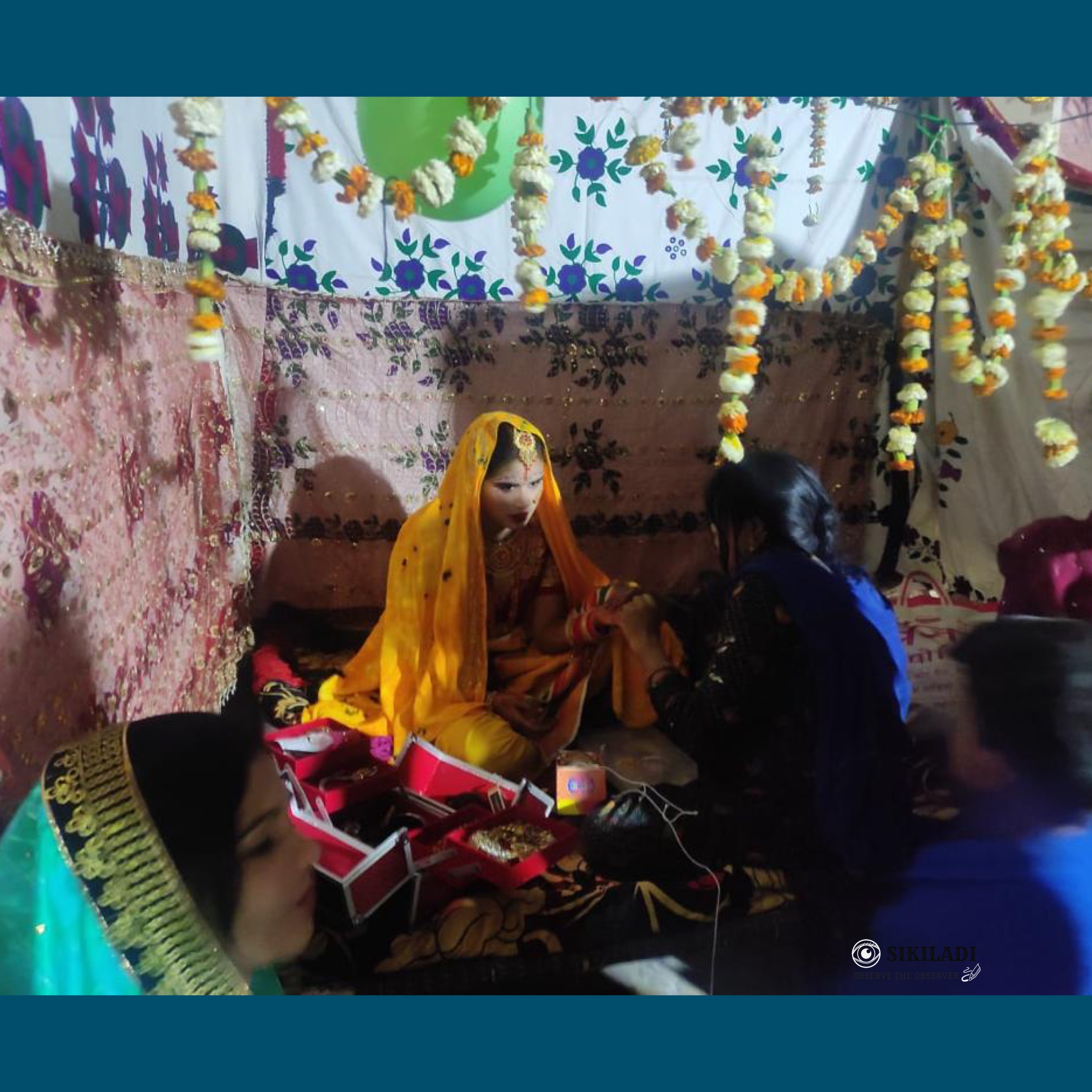
Looking at the scenes from Sindhi Weddings and the attire of brides and grooms from the refugee camps brings to mind the scenes from old sindhi movies and of course a similarity is found in our old family albums of black and white era – the photographs bearing a hallmark of the studio or the photographer, having rounded edges as a design for special effects.
They have moved on! We have moved on! Let’s look back at what have we left behind.
Sikiladi

P.S. This post is inspired by true story of two women known related to my family. Some facts mights have been changed as everyone’s interpretation changes down the family line.
The pictures used are from Sikiladi’s real life story Collection.
 Sikiladi
Partition story very aptly described. Sindhis weren’t timid, situation was abrupt and violent. Partition should have been done with a timeline of 10years – so that people could have sold thier property and planned to move safely. Further, the time for discussion of geographic split could have been there…
On brighter side, it is said that exodus from sindh witnessed minimal violence as compared to Punjab and Bengal.
I am sure there will be a revival of our culture again, which to some extent has started happening now…with the advent of social media….there are already many mini Sindh in India and I am sure one day we will have our own state which will give further impetus and thrust to revival of world’s oldest civilization. India is an integral part of Indus.
Thanks.
LikeLiked by 1 person
Thank you Bhau for reading this through and sharing your views. It helps me to learn more from you.
Being closely connected with upkeep of some refugee camps, my thoughts tend to find ways to lessen their suffering.
Revival as you mentioned, is definitely on the cards but we need to work towards it with awareness. You are very right about social media creating the image of a mini Sindh in India and I have myself participated in quite a few online programs for the same.
Wishing for fruitful times.
LikeLike