THE SUBTLE EFFECTS OF PERFORMING GARBA IN AN UNSATTVIK AND A SATTVIK MANNER!
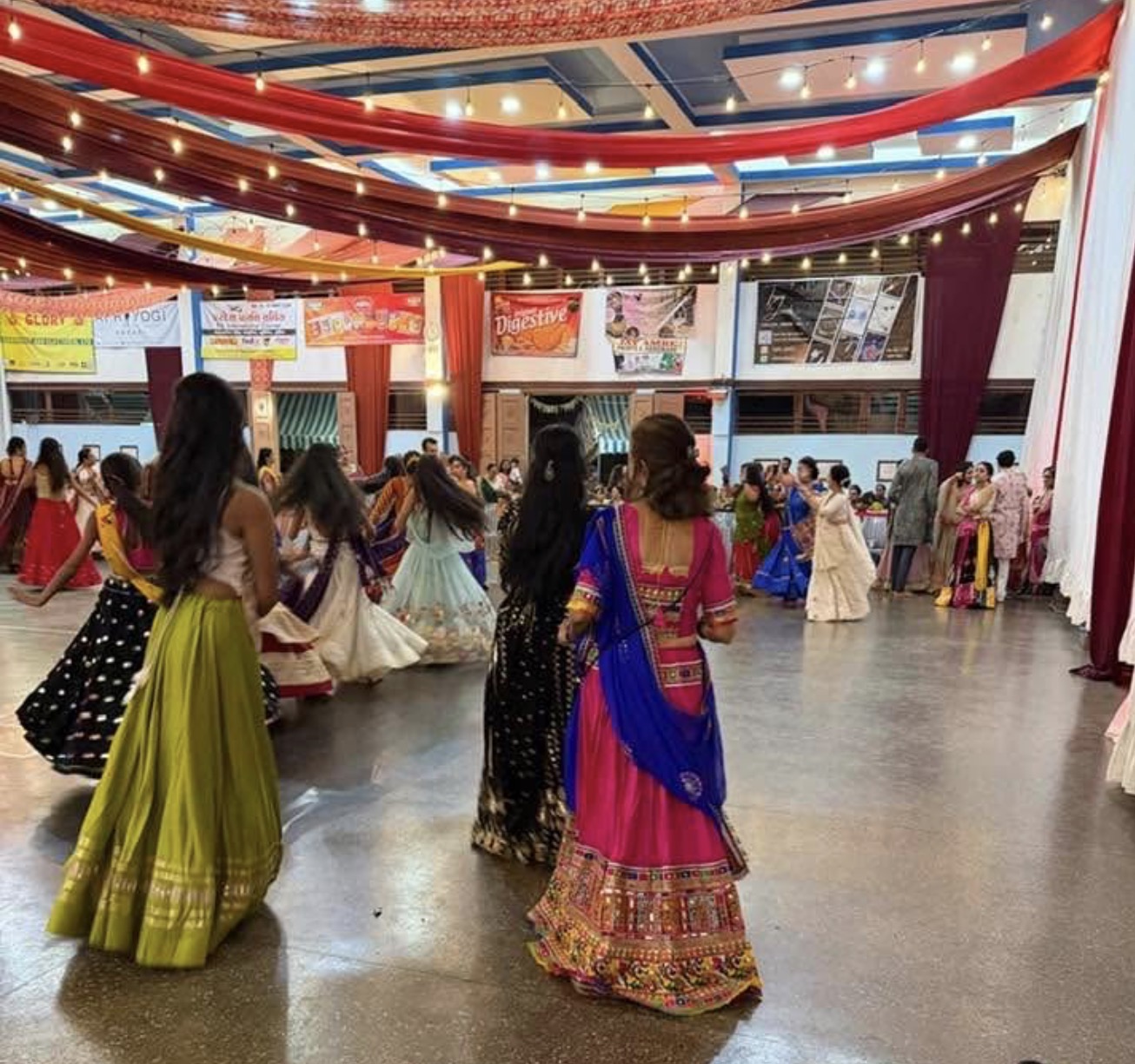
Garba originally derives from the concept of ‘Garbhadeep’ (a lamp placed inside a vessel symbolising the womb). It is an extremely sattvik (spiritually pure) and spiritual dance festival. In the traditional form, an idol of the Goddess or a ghat (a sacred pot, also called a garbo) is placed in the centre, and devotees dance in circles around it to worship the Goddess and receive Her energy. In earlier times, during Garba, only devotional songs dedicated to the Goddess, the divine play of Shri Krishna and songs composed by saints were sung.
At present, this collective form of worship of God through dance has become distorted and unsattvik. Performing Garba in an unsattvik manner means dancing merely for fun and entertainment, without remembering the Goddess or having any devotional emotion (bhav) towards Her. Instead of traditional devotional music, remixed songs, film songs and unsattvik music are used. The clothing worn is often revealing and intended to attract attention, while hairstyles are chosen merely for their attractiveness rather than for sattvik qualities.
During Navratri, the vibrations of the Goddess Principle and the Primordial Divine Energy (Adishakti) are active in the universe to a great extent. Performing Garba in a sattvik manner enables one to receive these sattvik vibrations and the Goddess’s blessings.
Conversely, performing Garba in an unsattvik manner increases the raja-tama-predominant vibrations in the environment. It provides no spiritual benefit and destroys the original sanctity of the festival.
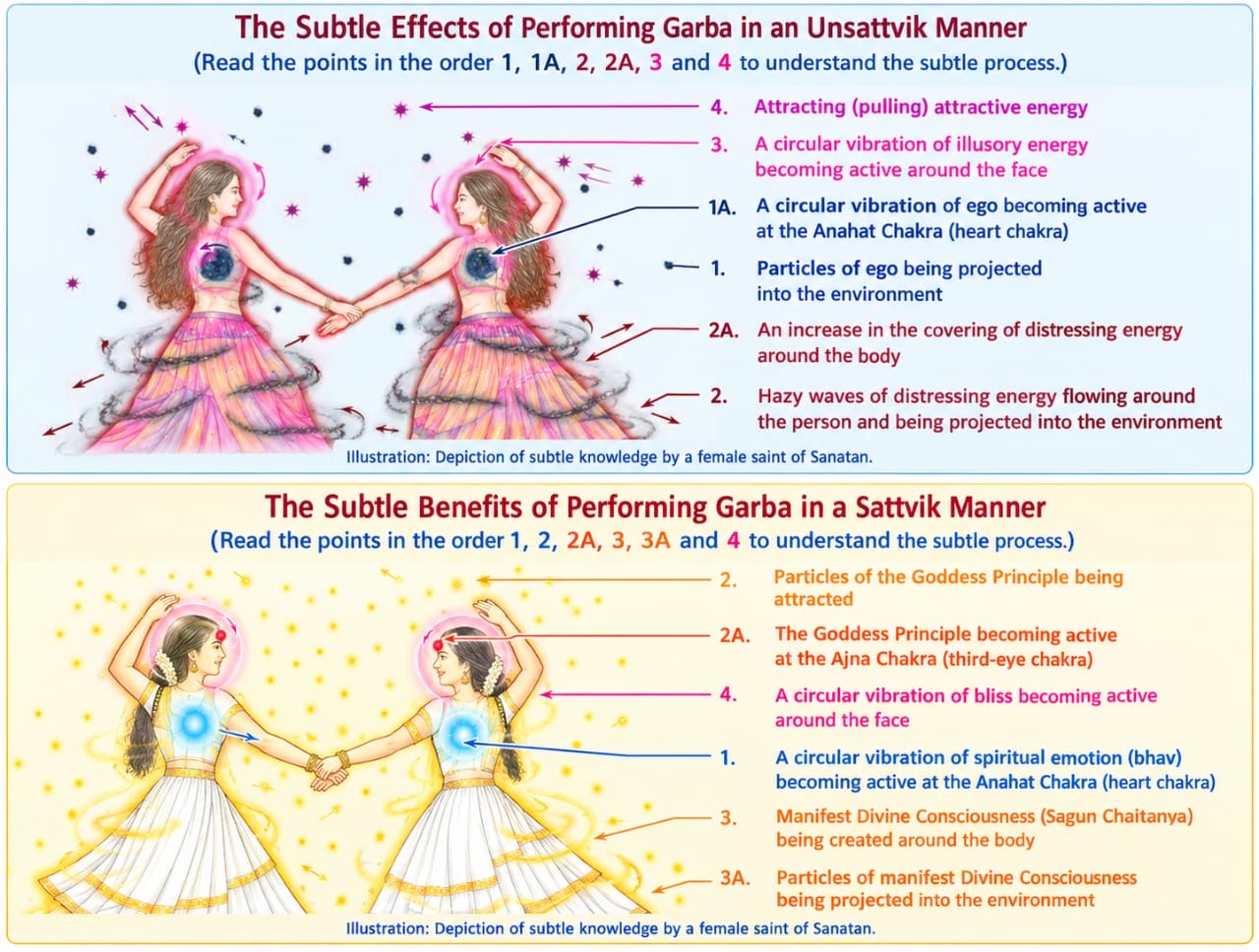
1.THE PROPORTION OF SUBTLE VIBRATIONS PERCEIVED IN THE IMAGES BY A FEMALE SAINT OF SANATAN AND SADGURU DR. MUKUL GADGIL. (Please see 2 Subtle drawings attached)
1.UNSATTVIK GARBA:
1A. EGO
1A1. A circular vibration of ego becoming active at the Anahat Chakra of a person performing Garba:
When a person performs Garba merely for entertainment, wears revealing clothing, leaves their hair loose and dances to film songs, a circular vibration of ego becomes active at the person’s Anahat Chakra (heart chakra).
1A2. Particles of ego being projected into the environment through the person and unsattvik music:
These particles of ego are also projected towards the people present nearby. They, too, are influenced to perform Garba in this manner, and ego develops within them unknowingly.

1B. DISTRESSING ENERGY:
1B1. Hazy waves of distressing energy flowing around the person:
When a person performs Garba wearing unsattvik clothing, leaving their hair loose and making obscene bodily movements to film songs, hazy waves of distressing energy flow around them.
1B2. Hazy waves of distressing energy being projected rapidly into the environment by the person:
The raja-predominant waves generated by unsattvik music and dancing cause hazy waves of distressing energy to be projected rapidly from the person into the environment.
1B3. An increase in the covering of distressing energy around the person’s body:
Performing Garba in unsattvik clothing and making obscene bodily movements to film songs increases the covering of distressing energy around the person’s body.

1C. ILLUSORY ENERGY:
1C1. A circular vibration of illusory energy becoming active around the person’s face:
The person thinks, “I am performing Garba for the Goddess, and I am deriving joy from it.” In reality, however, the person does not realise that performing Garba in an unsattvik manner does not establish a spiritual connection with the Goddess. On the contrary, the person’s spiritual distress increases.
1D. ATTRACTIVE ENERGY(Mayavi energy):
1D1. Particles of attractive energy influencing other people to wear unsattvik clothing and perform Garba in an unsattvik manner.
— Sanatan’s Saint
THE REASON FOR DIFFERENCES IN PROPORTIONS OF THE HIGHLIGHTED VIBRATIONS IN IMAGES DEPICTING SUBTLE KNOWLEDGE:
Some Sadgurus, saints and seekers of Sanatan acquire knowledge of the subtledimension. The proportion of vibrations highlighted in an image depicting subtle knowledge depends on various factors, such as the spiritual level of the seeker, the prevailing time and the person’s ability to perceive the subtle dimension. In the order of seekers, saints and Sadgurus, their ability to perceive the subtle dimension increases progressively. Therefore, there may be differences in the percentages of subtle vibrations identified by seekers, saints and Sadgurus.
2.SATTVIK GARBA:
2A. SPIRITUAL EMOTION (BHAV):
2A1. When a person performs Garba in a sattvik manner to devotional songs dedicated to the Goddess, devotional emotion towards Her is awakened within theperson. Consequently, a circular vibration of spiritual emotion becomes active at the person’s Anahat Chakra.
2B. THE GODDESS PRINCIPLE:
Since the person has devotional emotion towards the Goddess while performing Garba, particles of the Goddess Principle are drawn towards them in the form of blessings.
2B2. As the person establishes a spiritual connection with the Goddess while performing Garba, a circular vibration of the Goddess Principle becomes active at their Ajna Chakra ( third-eye chakra).
2C. MANIFEST DIVINE CONSCIOUSNESS (SAGUN CHAITANYA):
2C1. When a person performs Garba while wearing sattvik clothing, having a sattvik hairstyle and maintaining devotional emotion towards the Goddess, accompanied by sattvik music, manifest Divine Consciousness becomes active around their body.
2C2.Performing Garba to sattvik music causes particles of manifest Divine Consciousness to be projected into the environment.
2D. BLISS
2D1. A circular vibration of bliss becoming active around the person’s face:
While performing Garba, the person remains spiritually connected with the Goddess and experiences Her presence. Consequently, a circular vibration of bliss becomes active around the person’s face.
— Sanatan’s Saint
GLOSSARY OF SPIRITUAL TERMS:
1.NEGATIVE ENERGIES :
Both positive and negative energies operate in the environment. Positive energies help human beings perform beneficial actions, whereas negative energies cause distress. The Vedas and Puranas contain many accounts of demons obstructing the sacrificial rituals performed by sages and seers in ancient times.
The Atharvaveda contains mantras at several places to counter negative energies, such as Asuras, Rakshasas and Pishachas, as well as harmful occult practices such as Karani and Bhanamati. Various spiritual remedies for alleviating distress caused by negative energies are described in religious scriptures, including the Vedas.
2.SPIRITUAL DISTRESS:
Spiritual distress means the presence of negative vibrations within a person. According to the classification given in the article:
- Severe distress: Negative vibrations amounting to 50% or more.
- Moderate distress: Negative vibrations ranging from 30% to 49%.
- Mild distress: Negative vibrations below 30%.
Spiritual distress arises from spiritual causes, such as one’s destiny (prarabdha) and distress caused by departed ancestors. Saints or seekers capable of perceiving subtle vibrations can diagnose spiritual distress.
3.THE SUBTLE DIMENSION :
The physical organs that can be directly perceived are the nose, ears, eyes, tongue and skin. These are the five sense organs. That which lies beyond the perception of these five sense organs, the mind and the intellect is called the subtle dimension. Some individuals who have made spiritual progress can perceive sensations from this subtle dimension. Various religious scriptures refer to knowledge of this dimension.
4.SEEING OR HEARING IN THE SUBTLE DIMENSION, ETC. (ACQUIRING KNOWLEDGE THROUGH THE FIVE SUBTLE SENSEORGANS):
The inner vision of some seekers becomes awakened, enabling them to see things that are invisible to the physical eyes. Some others can hear subtle sounds or voices.
5.EDITORIAL NOTE ON SPIRITUAL EXPERIENCES:
The experiences published here are sometimes personal experiences of negative energies or personal experiences of seekers, saints and devotees of Dharma, in accordance with the maxim, “Where there is spiritual emotion, there is God.” Not everyone will necessarily have these experiences.
— Editor
6.THE SUBTLE WORLD:
That which cannot be perceived by the five physical sense organs—the nose, tongue, eyes, skin and ears—but whose existence can be realised by a person practising spirituality is referred to as the subtle world.
7.AN IMAGE DEPICTING SUBTLE KNOWLEDGE:
When seekers perceive something regarding a particular subject or see something through their inner vision, the image they draw on paper to depict these perceptions is called an image depicting subtle knowledge.
8.SUBTLE ANALYSIS (SUKSHMA-PARIKSHAN):
The perceptions experienced by the chitta (the inner mind) regarding an event or process are called subtle analysis.
DSP 17th Oct 2026.
Courtesy: Sanatan Sarthi
Teachings of Guru Athwale Ji

