For years we assumed and knew Vaisakhi to be the Sikh New Year but this new information was shared with me recently by a spokesperson of the Nanaksar Gurudwara in Nairobi, Kenya. I was quite surprised to know that the Sikh New Year had passed by and we weren’t even aware.
Sikiladi.
Report as received from Nanaksar Gurudwara
The Nanakshahi Calendar (translating from Faarsi/ Persian as The era of Guru Naanak- the Sovereign) is a Luni-solar calendar that is used to determine the dates of Gurpurabs (Historical occasions associated with the Gurus) and other festivals in Sikhi.
Years, seasons, months, and days (Saal, Ruti, Maahaa, and Vaar) are based on a solar calendar ie. the revolution of the earth around the sun, and dates (Thitee) are based on a lunar calendar (revolution of the moon around the earth). The Calendar is based on various Baanis (Divine revelations) from Guru Granth Saahib Jee ie-
- Rutee (Seasons) by the fifth Guru
- Barah Maahaa (Twelve months)- by the first and fifth Gurus
- Thitee (Lunar dates) by the first and fifth Gurus and Bhagat Kabeer Jee,
- Vaar (Days of the week) by the third Guru and Bhagat Kabeer jee
All the above Baanis describe and compare the gradual and cyclic changes in nature to the divine soul in each being.
Thus, according to Gurbaani, the Nanakshahi calendar and its new year begin with the month of Chet (Mid-March) that corresponds to the beginning of the season of Basant (Indian Spring) and also coincides with the Spring Equinox. As such, the Nanakshahi calendar sits in harmony and is in perfect sync with natural and celestial events.
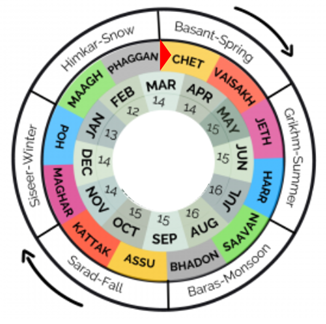
Basant season succeeds the harsh seasons of winter and snowfall. It therefore comes with rejuvenation of nature that is symbolic of the rejuvenation of the soul. Thus the Sikh calendar begins with this renewal. The calendar begins in 1469CE with the advent of the first Guru, Sri Guru Naanak Dev Jee. Currently, The Nanakshahi calendar is in the year 555.
The calendar has 6 seasons, 12 months, about 52 weeks and about 365 days
Other notable calendars that also begin in March include- Bikrami calendar, the early Roman calendar (which is no longer extant), Persian solar Hijri calendar, Shaka calendar, Ismaili calendar
 Sikiladi
Wow this is something, no one seems to know. Very interesting and thanks for sharing.
LikeLiked by 1 person
I am learning new information day by day being an editor of the Hindu Deep newsletter as I gather articles and meet people. Had to share it. Thank you for reading and the comment.
LikeLike